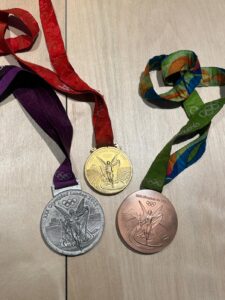
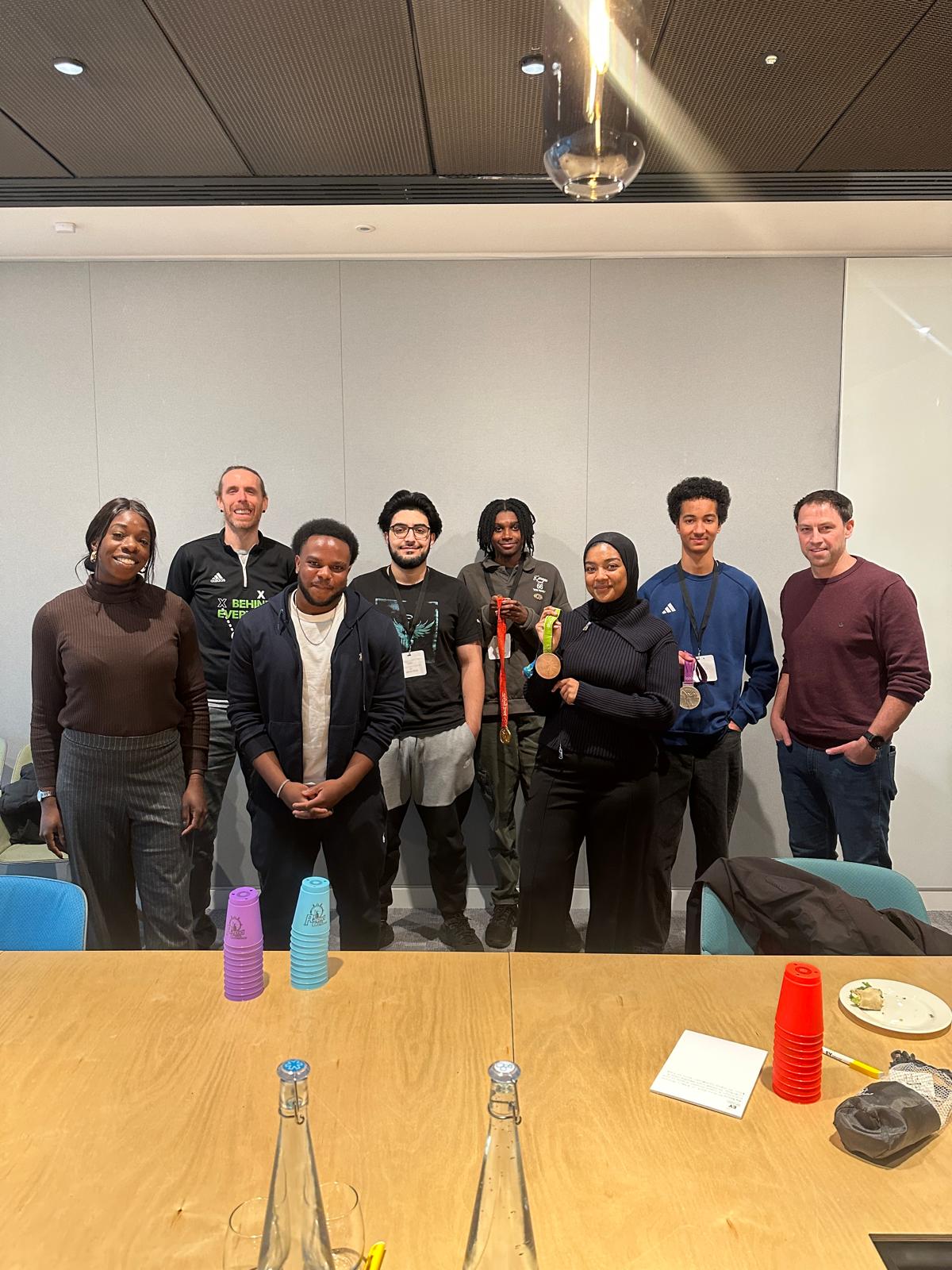
We all remember those conversations where suddenly something clicks, a curtain or barrier falls away, and a path to achieving what we want from life begins to appear. It’s fair to say that for the young people who came along to EY in London Bridge and grasped the opportunity to hear from Olympic medal winners Anyika Onuora and Mark Hunter, today will be a day they carry with them for a long, long time.
4×400 relay bronze medalist from Rio 2016, Anyika, took the event’s opening leg. She shared how, time and again, it had been necessary to overcome adversity in life to achieve her Olympic dream. Whether it be contending with a bout of malaria, injuring her Achilles and being unable to train for ten days before one of the most pivotal races of her life, or her father passing away in the build-up to the Olympics, Anyika’s passion for athletics and mindset of wanting to showcase her talent drove her forward. It was fascinating to hear how the medal-winning moments of ecstasy we see on television are such a small part of an elite sportsperson’s journey. Disappointment and failure are far more common than podium finishes. But it’s the desire to bounce back and go again that separates those who go on to achieve sporting immortality. Anyika smiles as she reflects on meeting people back in her home city of Liverpool who say, ”I remember I used to be faster than you at school”, or “I could have done what you did if I’d stuck at it.” Without wanting to be rude to them,’ says Anyika, ‘I always think to myself, “yeah, but you didn’t.”
‘Thanks to the foundations one of my early coaches helped me build, I came to realise in the moments I was struggling, or my motivation dipped, that love of my sport and the fun I have racing could be channelled to pick me up, get me to look towards the next competition and set a new goal for myself.’
It’s a mindset that has served Anyika well in her life after the track. ‘It’s still so strange to hear myself saying the word “retired”. But that transition from being an athlete can be incredibly challenging. I’ve made a conscious effort to always be open to opportunities and grab them. What’s the worst that can happen if you say ‘yes’? You might not succeed, but so what? If you don’t try, you’ll never know. I wrote my autobiography, and that led to an invitation to become an ambassador for the charity Malaria No More. I’ve met some amazing people as a result. I’ve been asked to speak to young people in schools, which I was delighted to do, and some of them have gone on to win medals at the Olympic Games. In 2024, I was offered the chance to be part of the television commentary team for the games in Paris. I had to learn loads of events at the Paralympics that were new to me. I approached it as I did when I was an athlete, preparing as well as I could to ensure that when I was on air, commentating, I delivered.
Anyika rounded off her part of the day with a great Q&A session before handing over to Mark. It was now time for the young people to be put to the test. Mark set up an activity that he has delivered to teams working for some of the world’s biggest corporations. It involves stacking 10 cups in a pyramid formation and then dismantling it as quickly as you can. Sound straightforward? The catch is that you can only hold the cups with one hand, can only touch one cup at a time, and if you knock a cup over, you have to start again from scratch. First, the young people honed their technique individually before coming together as a relay team to complete the task against the clock. The learnings along the way to an incredibly impressive 67 second best time were: build solid foundations – as Mark put it, ‘if you try to cover over cracks you’ll find they come back to bite when you least want them to’; don’t dwell on mistakes, if things go wrong focus on getting back on track rather than beating yourself up; be a good team mate – support eachother and create a collective culture where everyone is empowered to share their ideas about how to succeed.
Who’d have thought stacking cups would throw up so many good metaphors for life?
It was then time for Mark to share his story. His opening gambit was to challenge the young people to think about how they first felt about walking into EY’s plush corporate office – what preconceptions did they have about the people who work there? He then asked them the same question about his sport of rowing. ‘Private schools, rich, white, men’ were popular answers. Mark explained how he didn’t fit that mould. Having grown up in working-class East London while dreaming of playing for West Ham, his first experience of rowing bore little relation to the pomp and pageantry of The Boat Race or Henley Regatta. ‘I’d be out on the river in Poplar, having to navigate through tankers, rubbish and things you don’t really ever want to see. I can remember being selected for an under-18 camp. All the other boys were from private schools, like Eton. I felt totally out of place. I was a shy kid. But then I saw these guys, who were maybe looking down on me a bit, playing chess, so I asked if I could play. People see chess as an intelligent game, and I absolutely wiped the floor with them. They had to accept me then, didn’t they? That was always a great fuel for me, proving the people who said I’d never achieve anything wrong. That’s why I took things so hard when I came last in my event at my first Olympics, Athens 2004.’ Mark explained how that crushing disappointment took a severe toll on his mental health to the extent that he felt in as low a place as any person possibly can.
‘I was lucky,’ says Mark, his voice slightly cracking with emotion. ‘I had good people around me who recognised how badly I was struggling and were able to get me the help I needed. I was able to find a way to continue chasing the dream I’d had since I was a kid of being on the podium while the flag is raised and the national anthem plays.’ In its pursuit, Mark and his teammate Zac Purchase systematically reviewed every element of the way they trained and functioned as a team to achieve their vision – be it agreeing on what constituted being on time, washing their kit, or being mentally present at every session. ‘While we didn’t have much in common and weren’t particularly close away from the boat, there was no one else I came to trust more.’ Spoiler alert, four years on from the desolation he felt in Greece, Mark, together with Zac, won the gold medal in Beijing. And with that, Mark imparted one final nugget of wisdom to the enthralled young people. ‘I remember my mum said to me, “Things will change. You’ll now always be Mark Hunter, Olympic gold medalist, and people will have certain expectations when they meet you. You’ll only get one chance to leave them with an impression of you. What do you want it to be?” That’s something we all need to think about. What will people say about us when we’re not in the room? What impact do we want to have?’