
When Bank Station opened 126 years ago, it’s fair to say those alighting from the tube all had a certain stuffy look – think the bankers in Mary Poppins: bowler hat, rolled-up umbrella, dark wool suit, well-to-do, and exclusively white males.
Thankfully, as those Behind Every Kick graduates who attended a fantastic insight day at Alpha Bank London saw first-hand, things have moved on a fair bit.
That’s apparent from the minute Chief Executive Officer Joe Neophitou and Chief Financial Officer Jane Henderson enter the boardroom to welcome the young people and share their career stories. You might think that to occupy the two most senior positions at a firm like Alpha, you would have needed to work in banking your whole life and known it was the profession for you since childhood. As Joe and Jane confided, you’d be wrong.
Having completed a degree in management and textiles, Joe didn’t have a clear idea of the career he wanted. The way he found out was by getting stuck in and trying things out. ‘I figured out that I love problem-solving; that’s my strength, rather than being a mathematical genius, which I’m certainly not.’ As it turned out, there were no shortage of problems for Joe – who had successfully completed a graduate scheme at Bank of Cyprus and taken a junior position with Alpha Bank – to encounter. Greece, the country where Alpha Bank was founded, was at the sharp end of the financial crisis that engulfed the western world at the end of the first decade of the 2000s. ‘You get to see people at their best and worst in a crisis, and I learned so much from that. The bank needed to find ways to succeed even in the most challenging climate. I had built up good contacts in property development and suggested we concentrate on that. It worked out. That led to me being promoted, and I’ve worked my way up from there. The one bit of advice I’d give is always do what you say you’ll do. Don’t promise what you can’t deliver. If you do that, people will trust you and opportunities will come your way.’
Unlike Joe, Jane had always loved maths, but as she embarked upon her career, banking hadn’t appealed to her. ‘I was interested in science and was working for a chemical company that was doing some really interesting stuff. We actually developed one of the early one-coat paint technologies. But it wasn’t viable because the production costs were too high. That was a bit of an epiphany for me: things have to add up in business. I then trained as an accountant at PWC and became an auditor. I enjoyed travelling and spending time examining companies books. But eventually I realised I wanted to take ownership of what a business was doing and run a team. So I applied for a position at Santander, where I stayed for many years before coming over to Alpha Bank. I was curious, and I asked questions. People who succeed are curious, and I genuinely believe there is no such thing as a stupid question.’
With the CEO and CFO needing to crack on with running the bank, we were then joined by other members of the Alpha team, all of whom were keen to share their experience. Private Banking Manager, Androulla Kashoumeri, remembers her less-than-glamorous start in banking. ‘I was sticking stamps on envelopes. I didn’t want to do that forever, so straight away I asked my manager how I could learn more, and I kept asking questions.’ That enthusiasm paid off. Recognising Androulla’s ability to build a rapport with people, she was invited to shadow the team that opened accounts. Androulla had found her passion: customer service, and that driving principle of caring for customers has been at the centre of her long career at Alpha Bank, where she now works as Private Banking Manager. (In case you’re wondering you need £100,000 to open a private account, £300,000 for a corporate one!)

Bradley Leydon is new to Alpha Bank and new to the UK. Having been part of New Zealand’s rowing programme as a student, he made the long journey to London a year ago (presumably by aeroplane rather than rowboat). Having studied international business and accountancy, Bradley heeded the advice of an elderly family friend who told him, ‘If you want to know how money works, get a job in a bank.’ Working in Alpha Bank’s real estate finance team, he helps clients borrow money to buy buildings. Sounds pretty fun, doesn’t it? But as becomes clear in the fictional scenario Bradley sets for the young people in attendance to work through – weighing up whether to lend content creator ‘Alex’ £4 million to buy an £8 million space in Battersea Power Station – such decisions come with a lot of responsibility. ‘Bankers are professional worriers. We have to understand: who the client is; how they make their money; whether they can afford their repayments; what the property is worth; and perhaps most importantly, what can go wrong … every deal tells a story!’
Carlo D’Aiuto, Money Laundering Reporting Officer, spends much of his time preventing things from ‘going wrong’ at Alpha Bank. In the global financial system, all banks must be on guard against those who make their money through criminality and need somewhere to wash it up clean. ‘If you go into Curry’s and try to pay £3,000 in cash for a TV, it might raise suspicions’, explains Carlo. So people who have made their money from drugs or things like illegal blood sports need some way to get it into the banking system. I’ve always been interested in how organised crime works – I grew up reading about the mafia in Sicily and watching The Godfather films – and it’s fascinating trying to spot the flow of illgally earned money, investigate it and stop it coming into the bank.’ Carlo is quick to point out that he didn’t seem a likely candidate for such an important role when he left school with 3 GCSE’s at grades A-C. ‘I wanted to be a footballer and didn’t do that well at school. I started sixth form but didn’t like it, and left to work at Sainsbury’s. From there, I got a job in a coffee shop. An entry-level position came up at Barclays, and I managed to get in there. I could have made more of that opportunity in the first couple of years, but I eventually decided to push myself. While I was interested in the bank’s fraud prevention work, I didn’t have the experience they required. So I took a risk and joined a startup. Going somewhere small, you get the chance to meet the decision-makers, and that was the step I needed to get to where I am now – which is doing a job I really enjoy.’
Marketing wasn’t the first thing that sprang to mind when compiling a list of what goes on in a bank. Remi Pedro (Alpha Bank London’s Marketing Lead), however, makes a compelling case for its importance. ‘Monzo and Revolut have been able to tell a story about frictionless banking that’s really worked for them without big billboard or TV advertising campaigns. Ultimately, you’re trying to convince people to choose your brand over another. That’s no different for a bank. I did chemistry as my degree, but I have always enjoyed being creative, so I applied for an advertising internship. I was intrigued by the brand side of marketing, so I specialised in that. The wonderment of being a marketer is that you are constantly coming up with creative solutions under the pressure of targets and set budgets. Especially then, in fact. You get to find imaginative solutions. I think that will still be the case despite the onset of AI. There will be new roles for people that we haven’t even thought of yet. I’ve worked in marketing for 10 years now – hard to believe, I know [Remi says with a smile] – and I love it.’
Cassie Marshallsay accepted a 6-week contract at Alpha Bank London not long after finishing her degree in psychology. 25 years later, she’s still working for the bank, now as its I.T. Infrastructure and Security Manager. ‘I think I’ve stayed here so long because in my job no day is ever the same. We’re just about to launch our first app. Did you know it takes a bank less than a second to approve your payment, and in that space ot time it’s checked if the retailer is legitimate and whether you have sufficient funds. The technology is amazing … I could be doing things as diverse as writing board reports or dealing with attempted cybercrime on any given day – you wouldn’t believe the number of fraudulent emails we get. Some of them are very convincing.
Chief People Officer, Jen Peters, who has curated the day for Behind Every Kick’s young people, is the event’s final speaker. Jen, from farming stock in North Yorkshire, was the first person in her family to leave the area and the first to go to university. ‘Coming from a family of farmers, that was a big step. I didn’t know anyone who worked for a company or who I could talk to about careers. I was driven by my motivation not to be a farmer or a farmer’s wife. London was a big culture shock for me. I started working in recruitment. Quite early on, when the financial crash happened, there was a hiring freeze. I thought I’d get made redundant and have to go back to the farm. But I moved over to HR, and that’s where I’ve built my career because I’m passionate about people and helping them to fulfill their potential. The advantage of working in something like HR, I.T. or marketing is that you can work in any industry, as these functions are always needed. I worked at EY, which was a great experience. But I realised I wanted to work for a smaller organisation where I could get to know the team better and perhaps have more impact. I think for young people, the days of a job for life are gone. Transferable skills are what’s required, and the ability to forge and maintain relationships. One other thing I’d really like to impress upon young people is that employers conduct thorough checks on candidates, including what someone has posted on social media. People don’t realise that what they put online is there forever. If what someone has written would make colleagues uncomfortable or go against a company’s values, employers will take that very seriously when deciding whether to make a hire.’

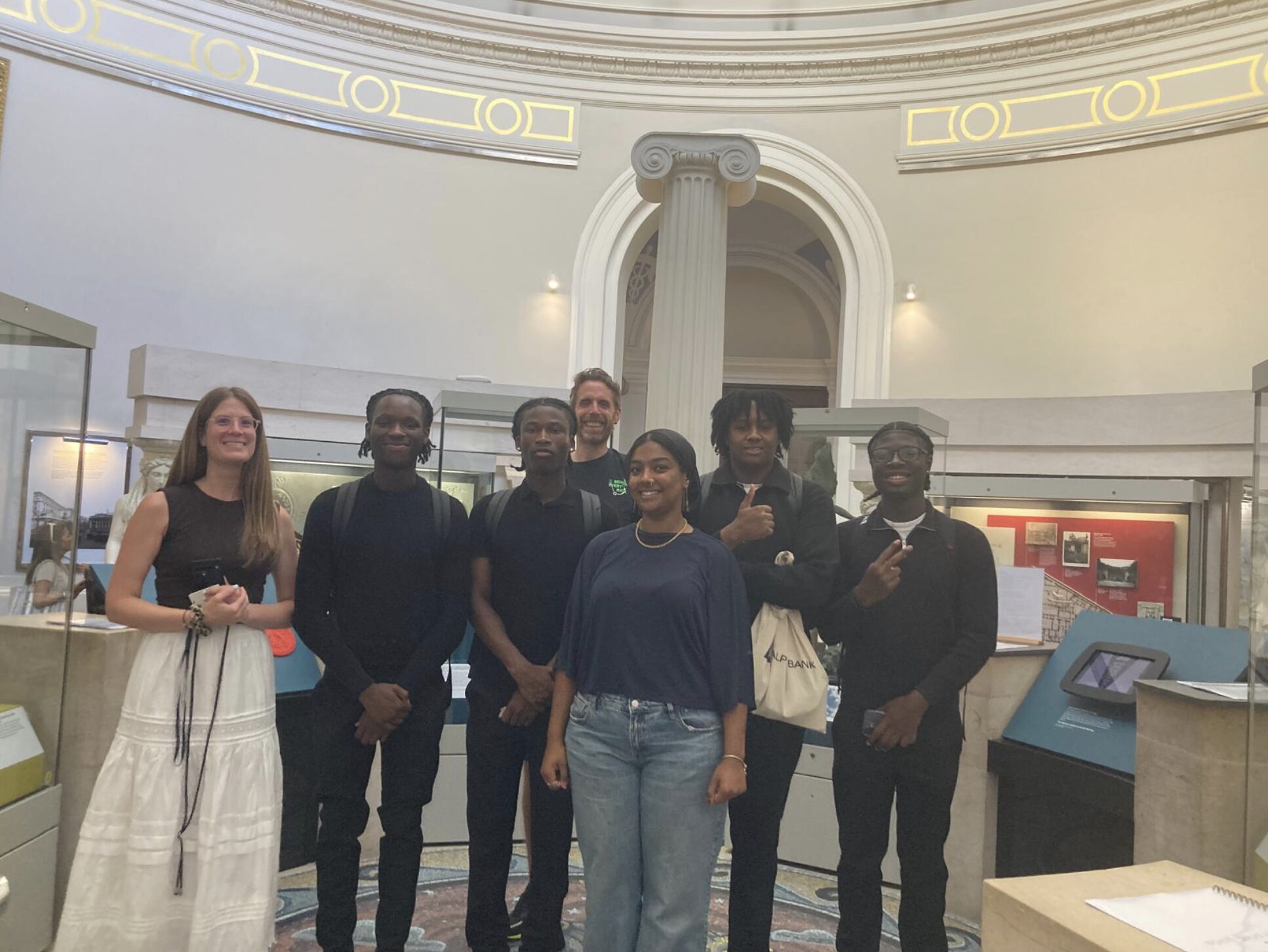
With those wise words, it was time for a whistle-stop tour of the Bank of England’s brilliant museum, complete with real beehive and the chance to lift a genuine gold bar, worth more than £1.3 million. Even more excitingly, so impressed were Alpha Bank London with the contributions of the young people during the day, they’ve offered to arrange job shadowing for all those who attended.
Taking opportunities like this – even in the summer holidays – really does pay dividends!